- DRIVEN.
- Posts
- The Engagement Engine: A Framework for Building Consistent Business Without Burnout
The Engagement Engine: A Framework for Building Consistent Business Without Burnout
How to design an engagement strategy that fits your strengths, your energy, and your people
The Three Engagement Zones
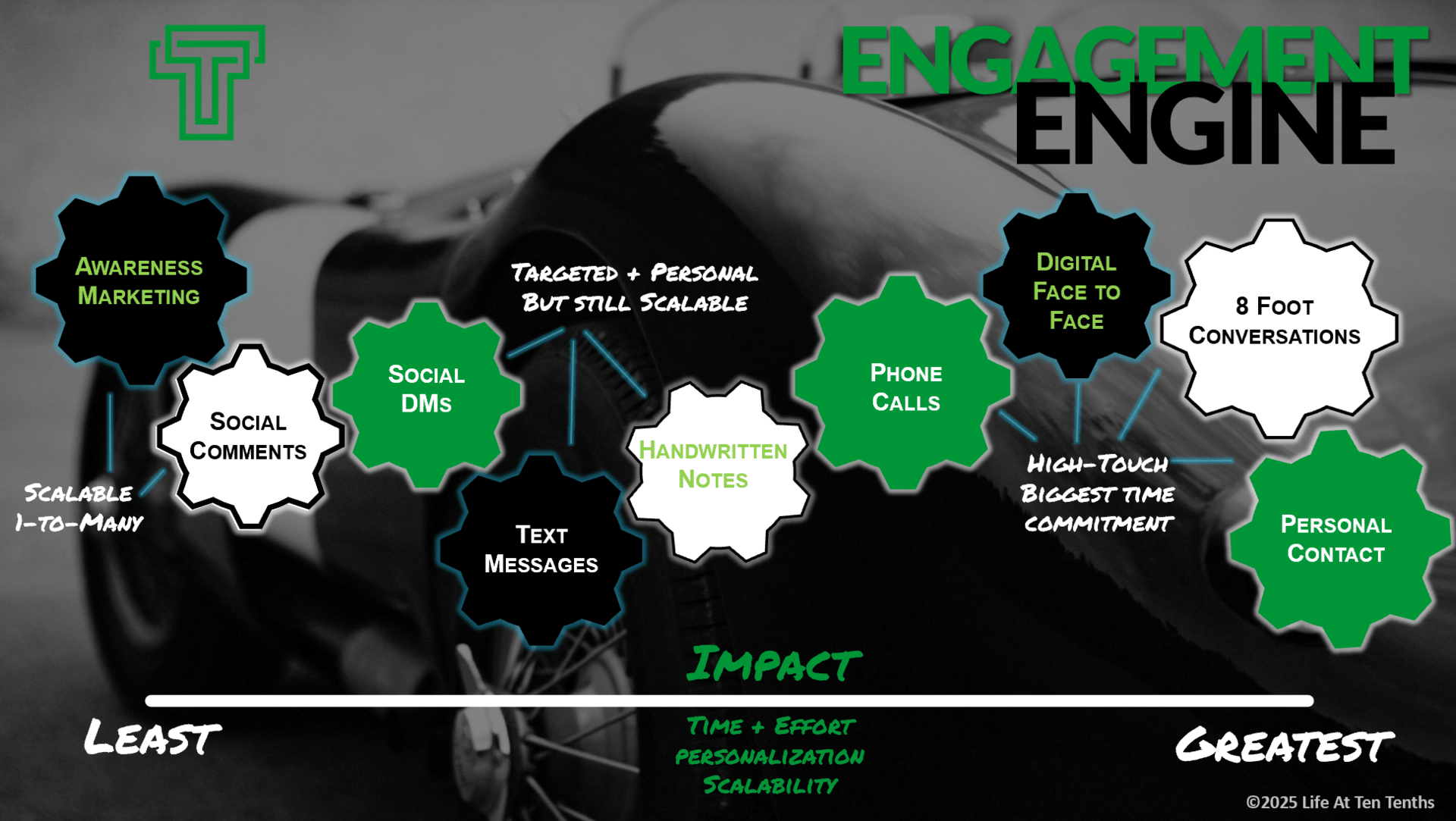
Zone 1: Scalable Awareness
(Least impact per person, greatest reach)
Includes:
Awareness marketing
Email newsletters
Social comments
Postcards
These activities are designed to create familiarity. Can help establish expertise.
They work by repetition.
They keep you visible.
They help people remember who you are when the time is right.
This is how you “buy space” in someone’s mind over time.
Danger: If this is all you do, your business will feel noisy but thin.
High activity, low depth.
Zone 2: Targeted + Personal
(Still Scalable)
Includes:
Text messages
Social DMs
Handwritten notes
These activities are:
Personal enough to feel intentional
Scalable enough to fit into real schedules
This is often the most sustainable zone for long-term growth.
It bridges the gap between awareness and relationship.
Zone 3: High-Touch Relationships
(Greatest impact, biggest time commitment)
Includes:
Phone calls
Digital face-to-face conversations
8-foot conversations
Personal, in-person contact
This is where trust accelerates.
Voice, presence, energy, and shared experience matter here.
This is where loyalty forms and referral behavior is born.
Why Most People Burn Out
Burnout usually isn’t caused by doing too much.
It’s caused by doing the wrong mix for too long.
Common mistakes:
Over-indexing on high-touch activities with no support system
Relying only on scalable outreach and wondering why nothing converts
Forcing yourself into engagement styles that don’t match your energy
When engagement feels heavy, inconsistent, or draining, it’s rarely a motivation problem.
It’s a design problem.
How to Use the Engagement Engine
Step 1: Identify Your Natural Strengths
Ask yourself:
What do I actually enjoy doing?
What do I follow through on consistently?
Where do people respond most positively to me?
Energy matters more than novelty.
Step 2: Choose Your Core Gears
A balanced engine usually includes:
1–2 scalable awareness activities
1–2 targeted personal activities
1–2 high-touch relationship activities
You do not need to use every gear.
You need the right combination.
Step 3: Set Standards, Not Goals
Goals describe outcomes.
Standards define behavior.
Examples:
“One weekly email”
“Five personal text messages per day”
“Two in-person conversations per week”
Standards create consistency.
Consistency creates results.
What This Looks Like in Real Life
One professional may build their business through weekly emails, strategic text messages, and monthly events.
Another may skip email entirely and focus on phone calls and in-person connection.
Both approaches can work—if the engine is balanced and aligned with the person running it.
There is no universal formula. There is only intentional design.
Download the Engagement Engine
Want a copy of the Engagement Engine framework?
👉 Download the Engagement Engine here
Want help building your own Engagement Engine?
👉 Explore the Business Planning GPS Workshop at tenten.co/gps
This framework will continue to evolve as we refine it.
|
